Collibra Data Intelligence Platform
Collibra Data Intelligence PlatformCollibra Platform is an active-metadata-driven data governance solution that unifies access and control of information across heterogeneous environments. It provides a centralized view of the enterprise's data assets, allowing technical and business users to discover, understand, and collaborate on data from a single platform.
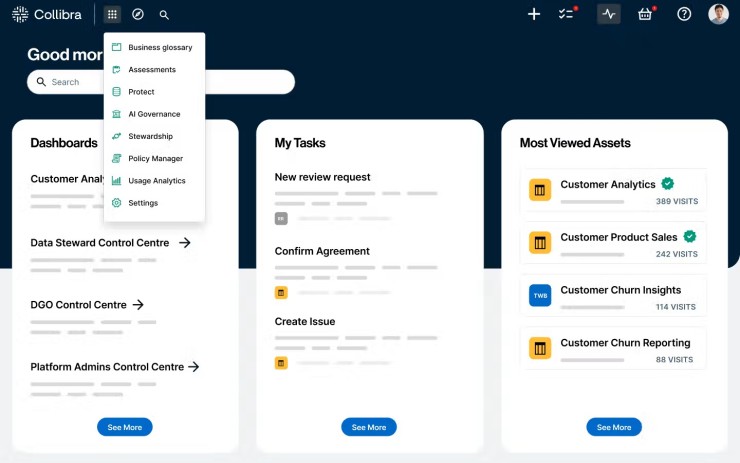
The platform groups specialized modules to cover the entire data lifecycle: a data catalog to register and classify assets; data governance to define policies, responsibilities and workflows; quality and observability to monitor and cleanse information; data lineage to track origins and transformations; and privacy and AI governance components that facilitate regulatory compliance and the management of data subject access requests.
Its architecture is based on a unified metadata graph, with open APIs, native connectors for cloud services and real-time notifications. It offers granular access control, detailed auditing, encryption of data in transit and at rest, as well as configurable user interfaces that facilitate cross-disciplinary collaboration and adoption by analytics teams, IT and compliance departments.
Collibra Platform Features
Data Catalog Collibra Platform provides a centralized catalog that indexes technical and business metadata from heterogeneous sources —relational databases, data lakes, cloud applications and BI— via native connectors. Each asset is enriched with descriptions, tags, profiling statistics and semantic relationships, which makes it easier to search for and discover relevant information. The catalog is updated automatically in real time, ensuring users always work with the most recent version of the data inventory.
Data Governance The platform enables a collaborative governance model by defining policies and standards, assigning stewardship roles and orchestrating approval flows. Responsible parties can configure business rules and quality rules associated with specific assets, as well as document responsibilities and incident escalations in auditable custody chains. In this way, robust processes are established that align IT and business objectives in terms of compliance and quality.
Data Quality Collibra integrates a quality rules engine that allows designing and executing periodic checks on metrics such as uniqueness, completeness, consistency and validity. The results of these rules are visualized in dashboards with configurable alerts, and each anomaly automatically generates incident tickets for the corresponding teams. This automated approach drastically reduces manual effort in detecting and correcting errors, maintaining trust in the organization's information.
Data Lineage Collibra's lineage component traces the complete path of data from its origin to its final consumption, breaking down each transformation —ETL, SQL scripts, visualizations— at the column level. Interactive diagrams allow assessing the impact of potential changes and speeding up regulatory audits. Additionally, lineage integrates with the catalog and quality policies, providing a comprehensive view of information flows within the company.
Privacy and Compliance With specialized privacy management modules, Collibra automates the detection and classification of sensitive data (PII/PHI) through data profiling and advanced analytics. It facilitates the handling of access, rectification and deletion requests from data subjects (DSAR), logging every operation in detailed audit trails. Thanks to predefined compliance templates for GDPR, CCPA and other regulations, organizations can demonstrate compliance audits efficiently and transparently.
Data Marketplace The Data Marketplace function centralizes the offering of internal data products, allowing users to browse, subscribe and request access to certified datasets. Each offering includes documentation, usage examples and quality metrics, fostering a self-service and reuse culture. The marketplace integrates with approval workflows and automatic delivery, accelerating the production rollout of analytical projects.
AI Governance Collibra extends its governance model to artificial intelligence and machine learning assets, offering traceability of models, training versions and performance metrics. Transparency and ethics policies are defined over data pipelines and algorithms, managing risks associated with bias and unexpected outcomes. This module ensures that trained models comply with corporate and regulatory standards from development through deployment.
Collaboration and Workflows The platform features discussion spaces, in-context comments and a "question wall" that store tacit knowledge about each asset. Customizable workflows orchestrate reviews, approvals and notifications to Microsoft Teams, Slack, Jira or email. This integrable collaboration layer improves adoption across different profiles (analysts, data stewards, compliance) and speeds up change management and incident resolution.
Technical Description of Collibra Platform
Collibra Platform is a comprehensive solution for data governance in complex enterprise environments, offering a modular ecosystem that unifies inventory, quality and compliance in a single control point. Thanks to its distributed architecture, metadata synchronization between on-premise systems and the cloud is seamless, while roles and permissions are configured granularly to adapt to any internal policy or external regulation.
The metadata catalog functionality automates the detection of assets from databases, data lakes and SaaS applications, enriching each element with descriptions, tags and profiling statistics. This shared repository provides semantic searches and advanced filters by domain or sensitivity, accelerating the localization of crucial information for developers, analysts and data stewards.
In the lineage and impact analysis module, Collibra generates interactive column-level diagrams that trace routes from ingestion to final consumption in dashboards. The visual representation highlights transformations, joins and calculations performed in ETL pipelines, enabling quick risk assessments when there are schema changes or critical variables.
The governance workflows incorporate a configurable process engine that automatically assigns owners, notifies approvals and executes escalations according to defined rules. Built-in templates cover everything from validating new assets to handling exceptions, ensuring full traceability and predictable response times.
Data quality is maintained through a set of definable rules —uniqueness, referential consistency, value ranges— that run on a scheduled basis. Alerts create tickets in systems such as Jira or ServiceNow, while performance dashboards display historical trends and compliance percentages that help identify critical points.
For privacy and compliance, the system detects and classifies sensitive data (PII/PHI) using customizable patterns, and coordinates DSAR (Data Subject Access Request) processes from a central portal. Every action is recorded in detailed logs, simplifying audits against GDPR, CCPA and other relevant regulations.
The RESTful APIs and webhooks extend Collibra's functionality by integrating with BI tools, ETL and DevOps platforms, providing flexibility to adapt governance processes to existing architectures. Custom reports and dashboard templates deliver key metrics —approval times, ratio of certified assets, adoption level— that support strategic decisions and the data roadmap.
Strengths and Weaknesses of Collibra Platform
| Strengths | Weaknesses |
|---|---|
| Unified metadata graph that offers a centralized view | Steep learning curve for users without prior experience |
| Modular architecture that allows gradual adoption and scaling | High licensing and implementation costs |
| Column-level catalog and lineage with interactive diagrams | Initial configuration complexity in very heterogeneous environments |
| Configurable workflows and policy automation | Dependence on specialized consulting for advanced deployments |
| Integrated quality and privacy with intelligent algorithms | Performance may degrade on very large graphs |
| REST APIs and native connectors for broad interoperability | Interface customization is limited without additional development |
| Extensive security and auditing with encryption and immutable logs | License and module management can be complex |
| Automated catalog with over 100 connectors that keeps metadata always up to date | Some AI and automation features require additional modules |
Licensing and Installation
Collibra Platform licensing follows an annual subscription model based on the number of users and modules, with different access levels (Viewer, Author, Steward, Admin) and specialized add-ons (Quality, Privacy, Data Intelligence).
Target company size ranges from mid-sized organizations that want to implement formal governance processes to large corporations with distributed, multi-site environments where centralized and scalable control is required.
Regarding the installation type, Collibra offers managed SaaS options in the public cloud, on-premises deployments in local infrastructures and hybrid architectures that combine both approaches to meet security, regulatory compliance and latency requirements.
References
Official page: https://www.collibra.com/platform