BI USABILITY: evolution and tendencies

Introduction

What is known today by the name Business Intelligence (BI) has an origin and evolution that should be looked at in order to introduce the concept that will be the subject of this article: “BI Usability”.

One of the principal goals of BI is that users find the information they need to make decisions in due time and proper form. The form includes, among other things, the format in which the information is presented and the level of interaction expected to obtain the desired result. The previous points make up the term “BI Usability”.


Usability can be defined as software’s ease of use, in which factors such as the familiarity of the design, comfort, attractiveness, level of interaction permitted, response time, etc. also come into play.

Various definitions of usability have been selected to complement the concept: (*1):

How to connect to a remote MySQL database

MySQL has some special features when making a connection from a remote client that if we do not know can complicate access to a MySQL database from a different machine that hosts the database.

With other databases such as Oracle or SQL Server, once that no firewall or anything like that prevents us from the client machine access to the server, using normally data acces from a database user we can 'enter'.

With MySQL, although access to the port, usually 3306, is open, the database can be configured to shut out external connections, and the result is the same as if the port was closed by a firewall..

Aspects to evaluate the selection of an ETL tool

Addressing a business intelligence project is important to proper assessment of the ETL tool that we will use. The tool based on which we will implement our procurement processes of the Datamart, Datawarehouse or storage structure based on which further exploit the data. It is a cornerstone for the design, construction and subsequent evolution of our BI system. We will analyze technical issues only, without entering into the economic aspects or otherwise (licenses, agreements, technical support, tool changes, etc. ..) . Note that the ETL processes, are closely linked to the processes of data profiling and data quality, here we will not consider.

Statistical Data Warehouse - European Central Bank

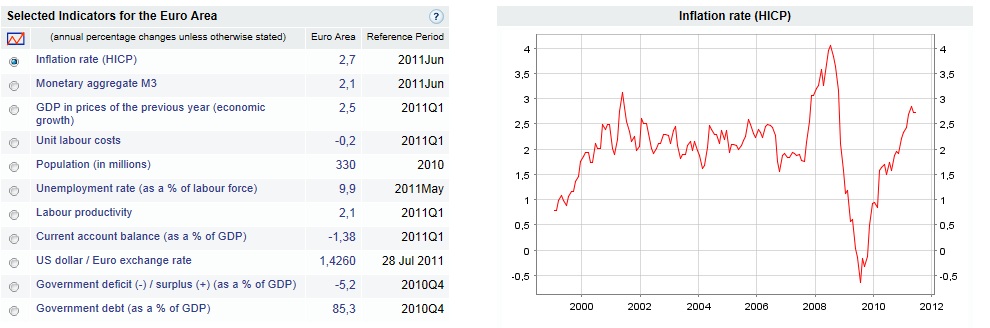
European Central Bank StatisticsI found very interesting the initiative of the European Central Bank, to provide a statistical service on-line in the so-called Statistical Data Warehouse (SDW).

This Data Warehouse is aimed at a broad spectrum of users (financial analysts, journalists, businesses, economists, researchers, etc. ..). Provides macroeconomic data on-line in the euro zone: inflation, exchange rates, labor costs, unemployment, productivity, public deficit, public debt, payments balance, international investment position, sociodemographic data, tax information, etc...

Learning NoSQL

The emergence of twitter, facebook, Groupon, amazon, etc ... is becoming increasingly popular new forms of large data storage and fast access to them. The terms NoSQL , Big Data , Hadoop ... are rapidly becoming popular.

Not long ago we talked about it:


- Comparison of NoSQL Databases ( Cassandra , MongoDB , CouchDB , Redis , Riak and HBase ) 
- Infographics, the potential for big data . 
- Pentaho also is accelerating much its integration with Big Data.


Today we give you some more detailed presentations, where we can research:  

Real Time Data Integration - CDC

There is an ever greater need in the Business Intelligence environment to have the information in the shortest time possible, data generation cycles getting shorter and updating of data in near real time. There is talk of 'Operational Business Intelligence (OBI)' and 'Real Time Decision Support'.

It is critical to reaching operational data analytic environments in shortest possible time. There is a need for a 'Real Time Data Integration'.

In the optimization of these data integration processes, we must consider both the usual source data (ERP's, CRM's, operating systems, databases, flat files, Excel, XML, etc. ..) and other from more immediate nature such as messaging queues and on-line information accessed via Web services or RSS.

In-database analytical solutions. Case SAS - Teradata

Within SAS solutions focused on improving performance and response time analytic environments highlights the effort with the proposed SAS In-Database. This proposal is accompanied by other high-performance solutions such as Grid Computing and SAS In-memory, which also improve performance, help manage the workload and improve the scalability of analytic environments.


SQL08: Create a conditioned table using the data dictionary of SQL Server

Sometimes we need to check the existence of a table in a script or scheduled task to record error logs, first executions etc ... 

Let us take an example, a package of integration services that normally distribute or run there where we go and that leaves traces in a custom table that is not the default for loading logs. We could always include a performance task or sql script, run right or wrong, as the first to run on the package and then continue. Being purists this just is not quite careful