SQL08: affinity_mask, IO_affinity_mask and like riding two on a single server environments without being "walked"

We put ourselves in position
In our environment we may need to have two replicas of a / s data base distinct environments (the classic example would be production and test). In deciding as we do the most common questions we must ask ourselves are:

- Is this new environment will be temporary? Does large data bases in terms of volume and / or load to be borne is high (even test)?
- Is there version SqlServer2008 development? That alone is at hand if you have an MSDN subscription ...
- Is there an extra server?

Based on these questions and all that it can happen one can opt for different solutions:
"The easiest and if the database to bear the burden are small we can use the same server for all databases (created on the same server with different names (_test) and Holy Easter ...). In order not to disturb each other we can use Resource Governor.
"The most" aseptic "if resources permit and where it would be worthwhile to mount on different servers (if we have the development version)
"Another option is a mixture of the above. Fit the two environments on the same server but different instances.
-Etc ...

1 server cpu n (n> 1) + 2 = 2 instances environments

Oracle10g: Manual standby database (initial approach)

An Oracle database in Standby is an exact copy of an operational database on a remote server, used as a backup, and copy for reference, disaster recovery, etc..

A database in the Standby mode is more than a normal backup because it can be put into production disaster in less time than if we had to restore a copy (either from a simple rman or export).Restore a copy from file takes time, and during this period the system is unavailable. With an additional database in standby mode there is nothing (or almost nothing to restore) in case of disaster. Within minutes, allowing the change is continuity of service. It offers the performance advantages of a cluster or safety of the mirror but the ratio of costs versus benefits and leave time seems right to me.

From a global perspective:

We release the weekly Newsletter Dataprix

Subscripción a la Newsletter Semanal de DataprixWe have modified the email subscription system to Dataprix content.
So far this subscription using the Feedburner system associated with the main RSS Dataprix to send automatically to every user subscribed to a daily email with the new publications of the previous day.

We decided to change this system to one that allows itself a subscription / low snapshot from the same page. For registered users only a matter of pressing a button, and the user is not only need to enter an email address and validate it later from the mail that will be sent.

Another advantage we get is that we will create a newsletter for each language Dataprix for each one would reach the new content of your preferred language.

Furthermore, the creation of the Newsletter will be weekly and manual, thus having the possibility to further customize the content of it, and select what they consider most interesting of everything published during the week.

The Newsletter is sent every Tuesday, referring to the new content published since the previous Tuesday.

Spectacular graphics that meets the key figures for Google

Spectacular graphics that meets the key figures for Google


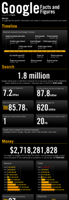
To get an idea of the volume of business that moves Google infografia nothing better than that prepared in pingdom, which collected on the same graph one timeline with key milestones of the company, impressive numbers on the form, increase in revenues , figures on company employees, and the most significant data on other successful products such as Android, YouTube, Blogger, Gmail, Chrome, Orkut or Analytics.

A good source of inspiration for anyone eager to create a scorecard where we could see these evolve dynamically as so well chosen indicators.

Surely more than one person has clicked on an indicator in the chart to see if anything more;)..

Oracle10g: Change the character set of the database

It may happen that after you install or configure a new Oracle database we realize that the character set chosen during installation is not correct. What we may happen in cases like this is to delete the database and reconfigure it or worse ...But you do not. We can change the character set stopping the database, looking up strictly by changing the settings and restart the database. Howto:
 

- First we connect to the database 

$ sqlplus sys/pwd@prod as sysdba
 

- We stop the database 

SQL>SHUTDOWN IMMEDIATE;


- We raise strictly * 

SQL>STARTUP MOUNT;
SQL>ALTER SYSTEM ENABLE RESTRICTED SESSION;
SQL>ALTER SYSTEM SET JOB_QUEUE_PROCESSES=0;
SQL>ALTER DATABASE OPEN;

- Change the character map 

SQL>ALTER DATABASE CHARACTER SET <new characters map>;

- Restart the database and yata 

Pentaho BI Server 3.5.2 stable

A few minutes are up to publish the stable versions of Pentaho BI Server 3.5.2.

You can download it at: https://sourceforge.net/projects/pentaho/files/
 

I have not reviewed this version, but I am doing beta testing before and have found no major changes in the UI, just some updates of bookstores, but not widen too much.

Whenever I get more information, I have the relevant comments.

Greetings
 

Twitter will migrate from MySQL to Cassandra DB

Cassandra is an open source database distributed, is one of the noteworthy projects of the Apache Software Foundation and appears to be hitting hard. By being distributed enables high availability, fault tolerance and, above all, a highly scalable without loss of performance.

And were using companies that handle large amounts of data such as Rackspace, Digg, or Facebook, and the list is expanding.

The latest news, coming from a blog interview with Ryan King MyNoSQL is that Twitter is considering migrating their MySQL server clusters Cassandra DB.
 

This is a product presentation, which can be found in the same web Cassandra Project 

Update SQL Server table statistics dynamically throughout a database

In Oracle databases there is a table that allows to list all the tables in the database (table 'dba_tables') and we can use this 'dba_tables' to create maintenance scripts dynamically.  In SQL Server we can create also scripts of tables maintenace by querying the table [dataBase].dbo.sysobjects.

In the example below we use a T-SQL script to update statistics for all tables in a SQL Server database by querying dynamically the data dictionary (using the table dbo.sysobjects). This T-SQL code can be encapsulated in a stored procedure or in a job to be executed by the SQL Server Agent to automatically keep statistics updated on all tables of the dbo scheme in a SQL Server database.